
Virginia Financial Literacy Statistics
The Virginia Financial Educators Council (VFEC) performs research to identify trends and conditions related to financial wellness among Virginians. Updated data are housed on this website and serve as a foundation for education-focused policy and advocacy. By equipping key stakeholders – including policymakers, researchers, community organizations, and nonprofits – with reliable information, the Virginia Council supports the continued growth and performance of financial literacy initiatives statewide. This is just one way in which we contribute to propelling the financial wellness movement forward.
Cost of Financial Illiteracy Survey
Virginians report that lack of financial knowledge carries a high cost, according to the NFEC’s most recent survey. Participants across the state responded to the single question: “During the past year, about how much money do you think you lost because you lacked knowledge about personal finances?” The results are shown below. Since 2017, the NFEC has conducted this annual survey, consistently revealing that the average individual cost of financial illiteracy approaches or exceeds $1,000 per person – with estimated national losses reaching into the hundreds of billions of dollars each year, and losses in the hundreds of millions across Virginia.
Cost of Financial Illiteracy
$0 – $499
$500 – $999
$1,000 – $2,499
$2,500 – $9,999
$10,000 +
Financial Vulnerabilities Experienced by Virginians
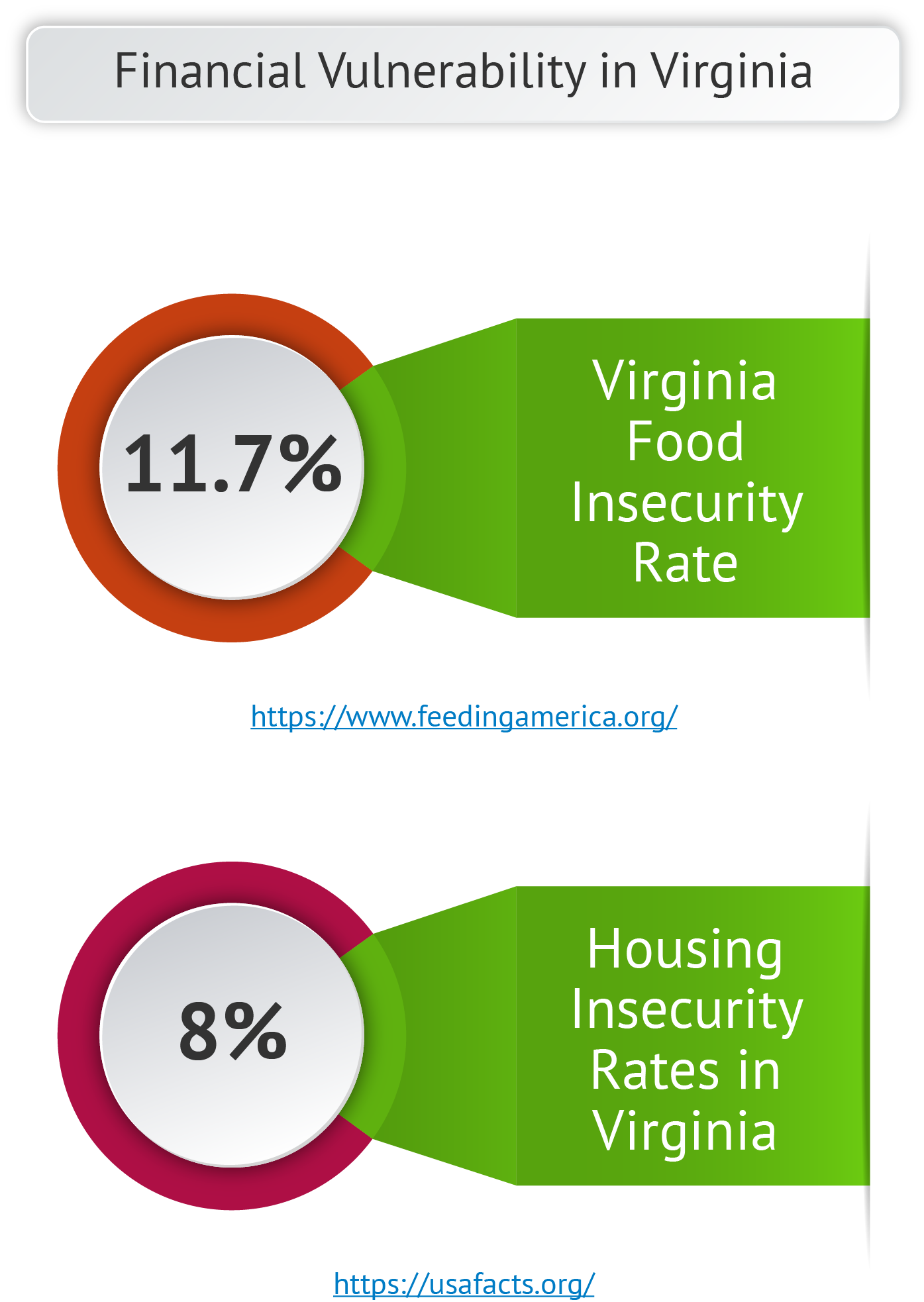
We collect ongoing data on two metrics that define financial vulnerability among Americans: food insecurity and housing insecurity. Feeding America, a nonprofit organization that tracks hunger statistics around the country, estimates that over a million Virginians (1 in 8; 11.7%) are experiencing hunger, and these people reside in every county and congressional district in the state. Out of that group, 261,730 individuals are children.
According to a report from the World Population Review (WPR), 7,141 people were unhoused in Virginia as of 2024, a homeless rate of 8% statewide. That figure had decreased by 26.7% since 2007, but still represents a not insignificant issue in the Old Dominion State. WPR also lists (in order) the four top reasons why Americans are homeless: lack of affordable housing, unemployment, poverty, and low wages.
Statistics on Virginians’ Financial Situations
Average Total Consumer Debt
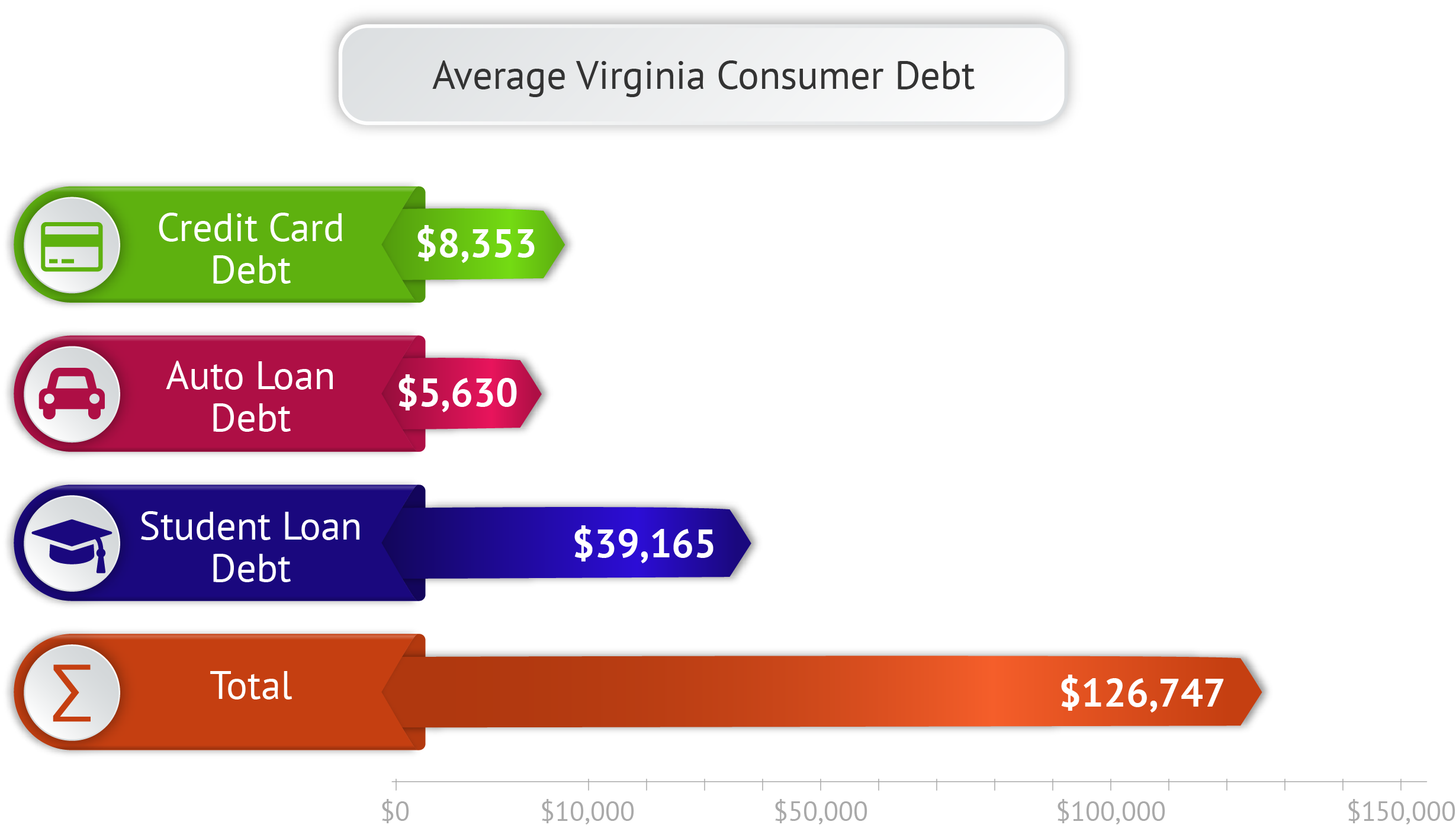
Total consumer debt represents a significant problem across America, with levels reaching over $18 trillion as of 2025. In Virginia, the average total debt per consumer was $126,747 in 2025, as reported by Experian. As that figure is substantially higher than the nationwide average of $104,755 that year, it becomes apparent that debt remains a problem in the state.
Debt by Specific Type
Further research revealed that Virginians with student debt balances owed an average of $39,165 on those loans in 2026, according to the World Population Review. In terms of credit card debt, WalletHub estimated that the Old Dominion average balance was $8,353 per user in 2026. Further data from WPR indicate that the average owed on a vehicle loan in Virginia was $5,630 in 2024, a number that is only likely to have increased over time.
Virginia Financial Literacy Legislation and Education Statistics
In a periodic report from the National Education Association (NEA), the agency sets forth data characterizing the number of school districts, educators, and student enrollments for each U.S. state. The most recent report was published in 2025. During the 2023-24 academic year, Virginia had 131 operating public school districts and a total student enrollment of 1,245,546. With 106,641 educators employed to serve those students, we can extrapolate a ratio of 11.7 students to each teacher.
Virginia requires a standalone personal finance course in high school through its requirement of a one-credit course in Economics & Personal Finance. The requirement was implemented beginning with the graduating class of 2015. Virginia also provides the W!SE Personal Finance Certification Test and the Governor’s Challenge in Economics and Personal Finance as optional assessment tools for high school students. Students can obtain a Financial Literacy industry certification through the W!SE test.
Legislation relevant to these requirements included 2005 Virginia Chapter 741 (Senate Bill No. 950) which mandates that “the Board of Education shall develop and approve objectives for economics education and financial literacy at the middle and high school levels, that shall be required of all students, and shall provide for the systematic infusion of economic principles in the relevant Standards of Learning, and in career and technical education programs.” Virginia 2009 Chapter 802 (House Bill 2112) also required that local school boards implement “educational objectives in middle and high school that emphasize economic education and financial literacy.” In 2021, the Virginia legislature voted to add language related to the gig economy and evolving employment forms to the list of required economics and financial literacy education objectives.